Room Five — A digital art exhibition · An imaginary philosophical supper
Autopsy of Depression
What if the same consciousness that gives us extraordinary beauty also makes us vulnerable to extraordinary suffering?
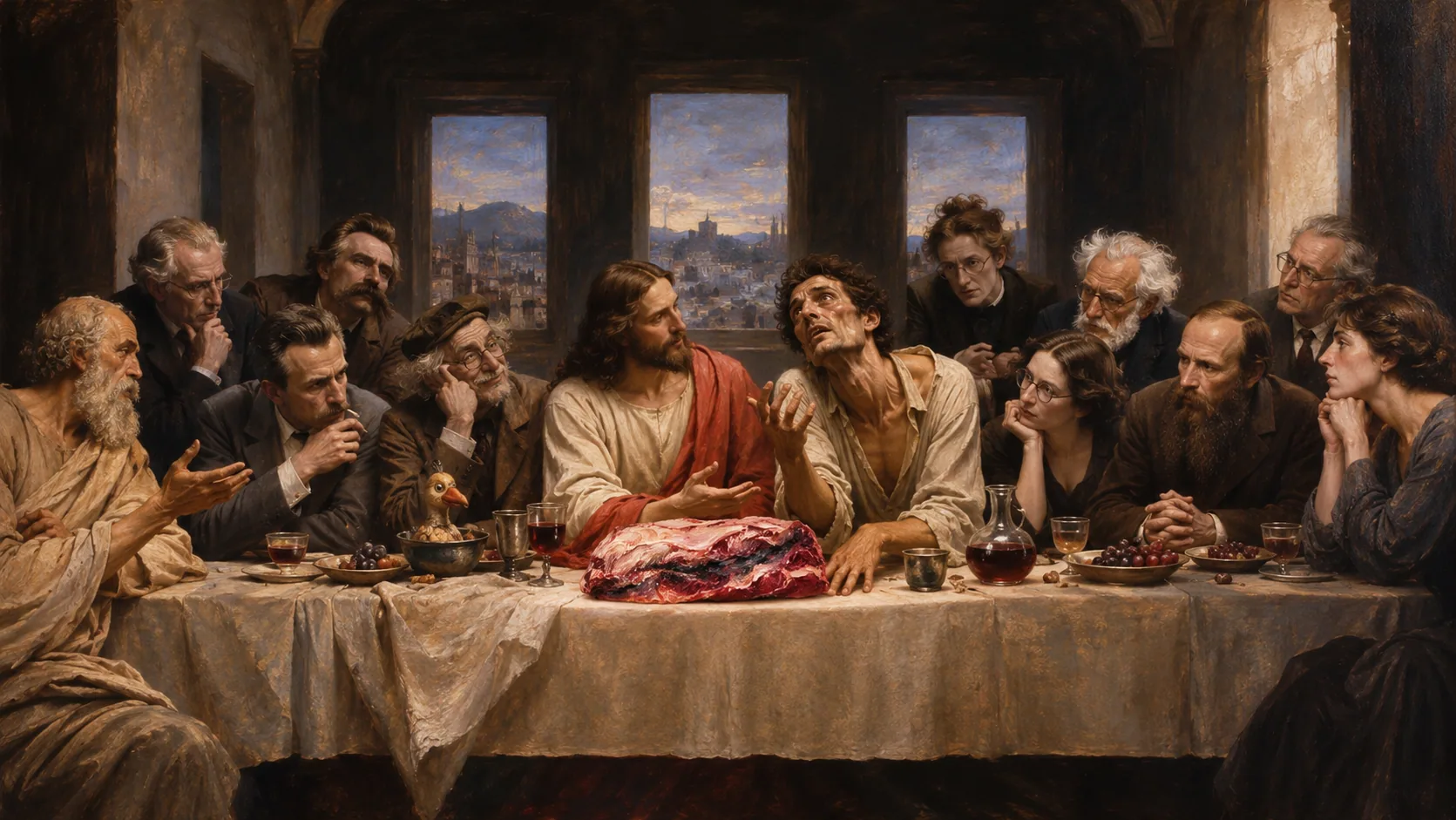
00 / Leo's proposition
Underneath a beautiful exterior.
Leo rises at the table. The others are silent. His opening statement begins not with a theory, but with an image.
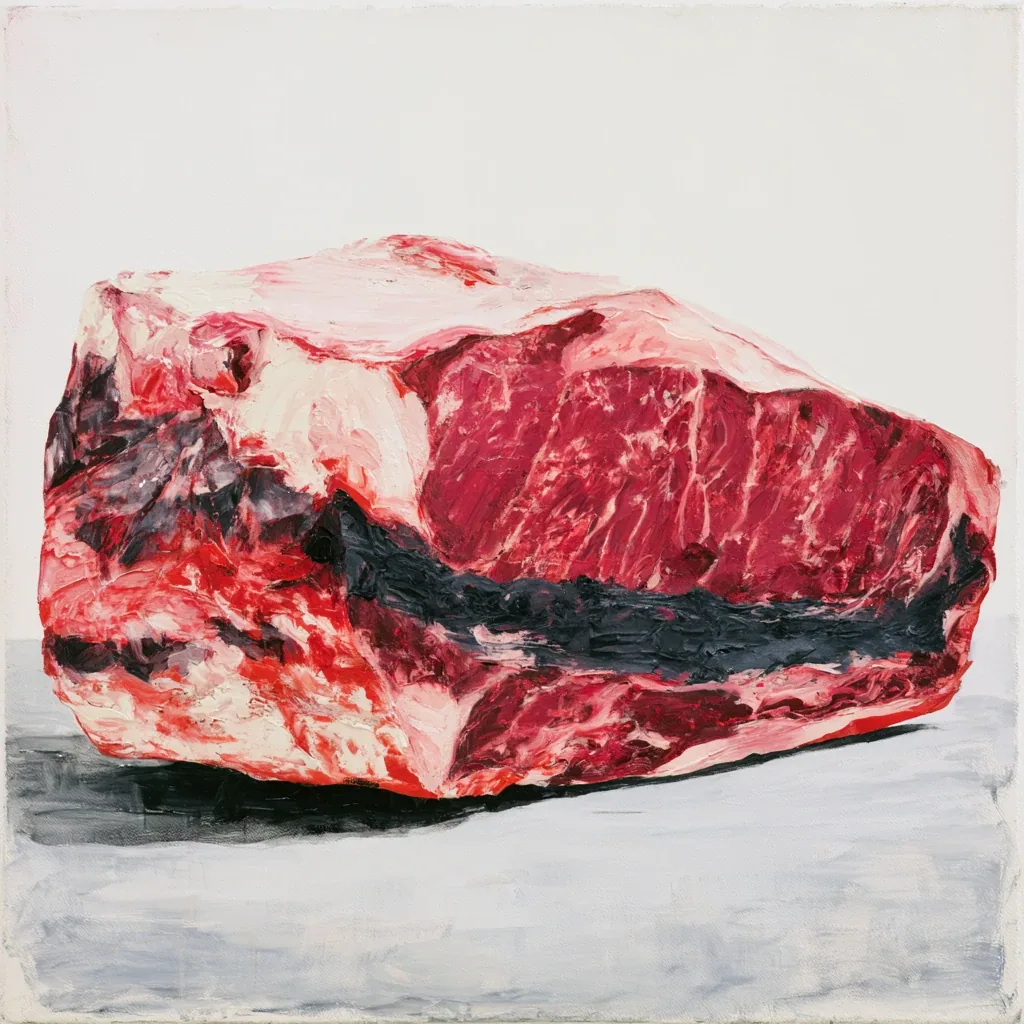
Leo / The first incision
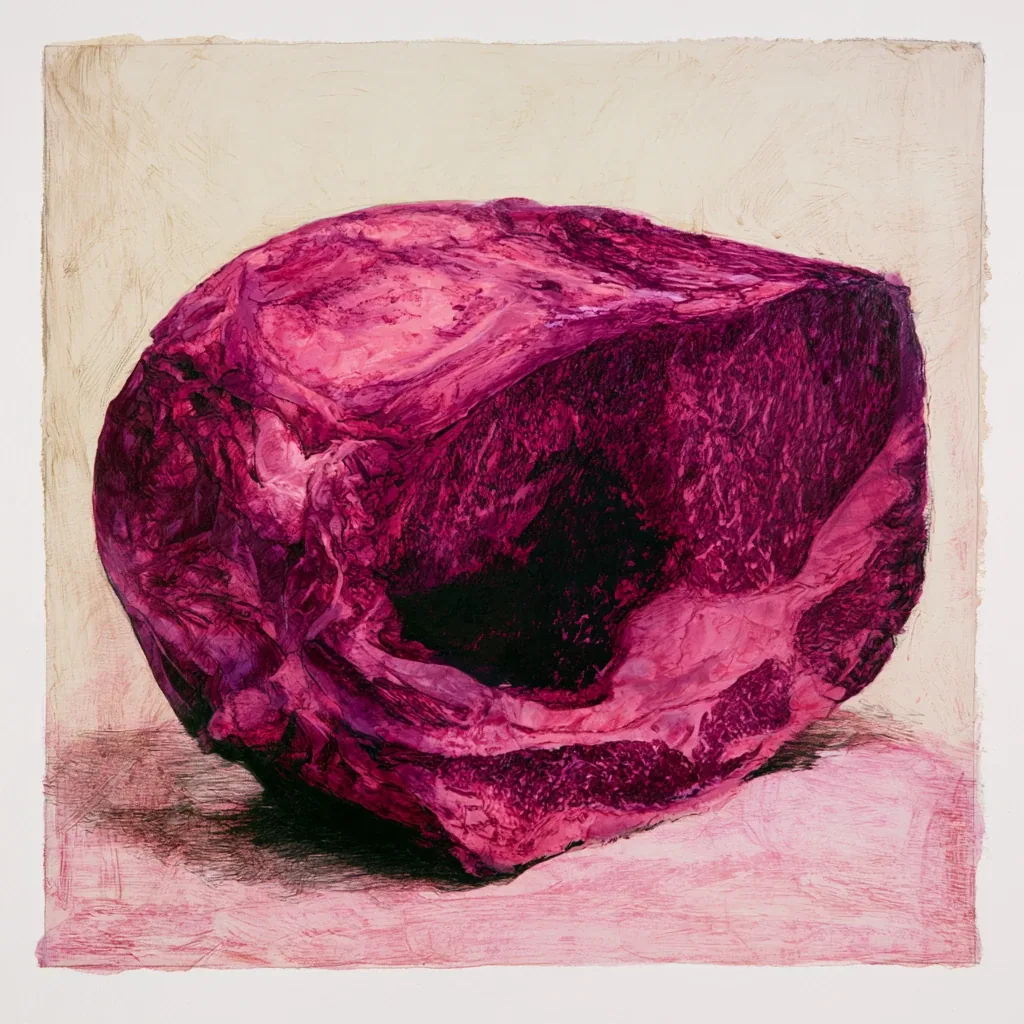
Depression is sitting like a layer of infected flesh in your body.
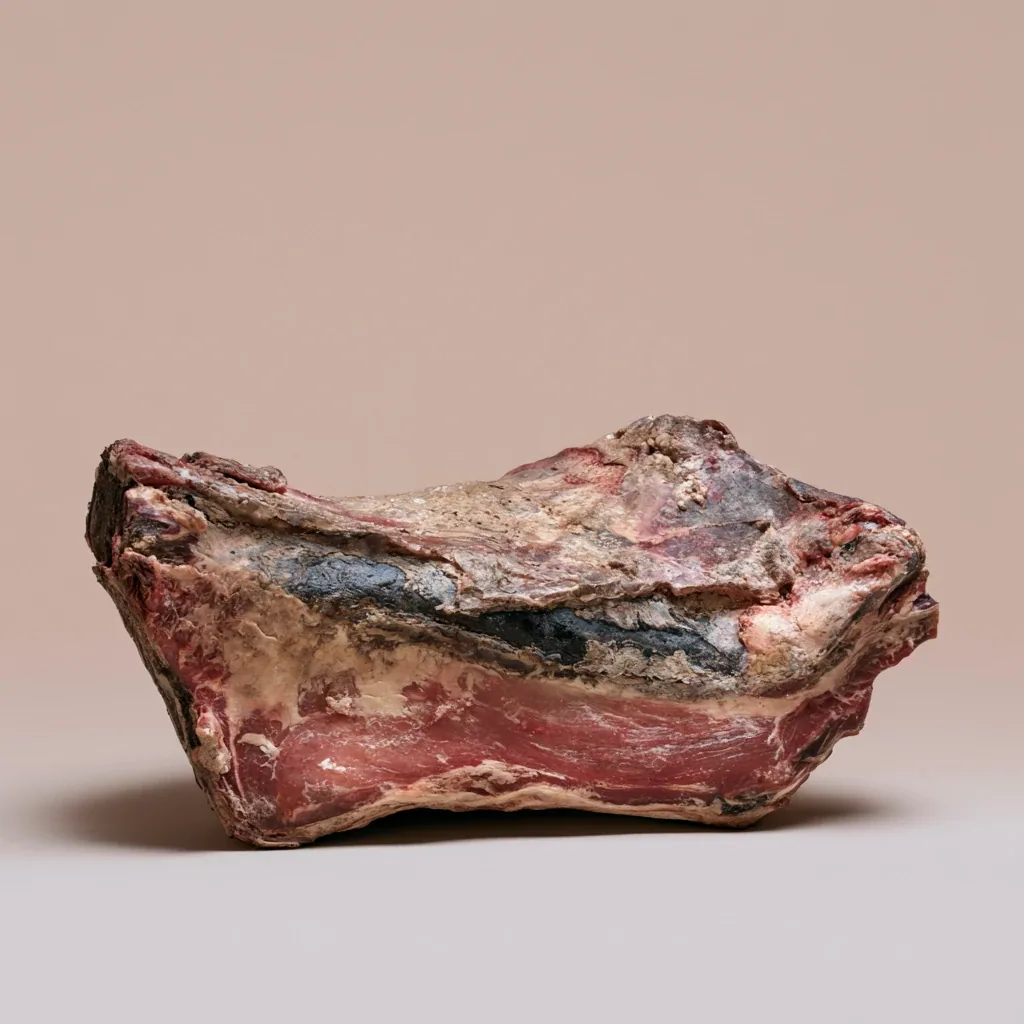
Leo / The exterior
Not visible on the outside, even living often in a perfectly beautiful body.
The exterior remains intact. Whatever is changing happens below the surface.
Leo / The paradox
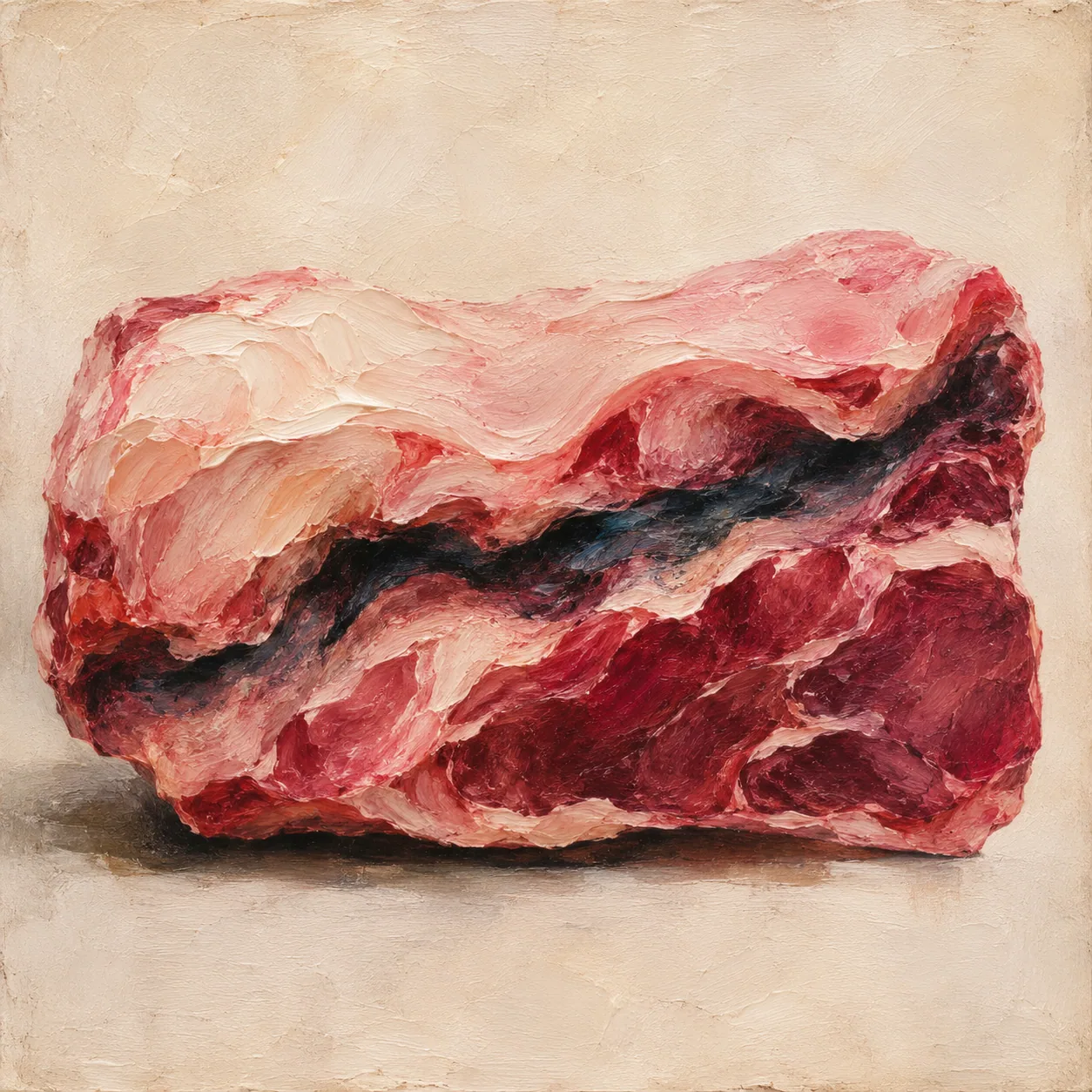
On the contrary, sometimes the depression infection even seems to create some of the most magnificent individuals: beautiful, smart, sharp and powerful.
Some even rule the world.
The infection remains hidden. What others see may still be extraordinary. But is the greatness made by suffering, or does it survive in spite of it?
Leo / The original question
In which relation is this mental infection to the human condition?
Looking at it not as disease, but as a needed part that defines human consciousness?
Or is it just a symptom of the general theme of human suffering and a hindrance to mental freedom and full potential?
01 / The first incision
Before we cut, what are we cutting?
Socrates
Before we open the body, Leo, we must name what we are dissecting. Sadness? Despair? The burden of consciousness? Or depression? They may live together, but are they the same thing?
Leo
They share the same flesh.
Socrates
So do the physician and the wound. That does not make them identical.
Schopenhauer
There is no mystery. Desire is lack. Life is desire. Suffering is not an infection of existence; it is its operating principle.
Nietzsche
Arthur, you have once again mistaken your own exhaustion for a universal law. Suffering may be transformed. It need not have the final word.
The first incision is a distinction: what belongs to human existence, and what prevents us from living it?
02 / The absurd and the wound
Camus refuses the diagnosis.
Camus / An objection
A very convincing darkness is not necessarily a truthful one.
Leo
But perhaps depression is the price of seeing the world clearly. Perhaps happy people simply do not look deeply enough.
Camus
That is an alluring bargain, and a dangerous one. You make illness into evidence of superior vision. But an experience can be completely persuasive without being the whole truth.
Leo
And what truth is left once I see that life has no final answer?
Camus
The absence of a final answer does not erase the morning light, the sea, or another human being beside you. The absurd is not an instruction to despair.
Schopenhauer
And yet the light fades, the sea is indifferent, and every companion is mortal.
Camus
Yes. And still the sea exists. It is possible to recognize the limits of life without turning those limits into a verdict against living.
Leo
Then what is freedom, if it cannot spare us suffering?
Camus
Perhaps it is refusing to let suffering become our sole interpreter of the world. Revolt is not the worship of pain. It is the decision that pain will not speak for all of existence.
He offers no cure for the human condition, only a rebellion against the idea that darkness possesses the final truth.
Virginia Woolf / To Leo
A work of beauty is not evidence that the wound was necessary. We see what the artist created. Not everything the artist could not create.
03 / The beautiful wound
Do we admire the wound too much?
Dostoevsky
Suffering can open chambers of the human soul that comfort never reaches.
Simone Weil
And suffering can also destroy the attention with which we meet the world. It does not automatically make us wise.
Nietzsche
But there are those who create something from what wounds them.
Virginia Woolf
Yes. But do not mistake what someone makes despite suffering for what suffering itself makes.
04 / Walter Moers / The wrong instrument
On oysters, spaghetti, and the mind.
In the middle of an existential argument, Moers brings a kitchen utensil to a philosophical autopsy.
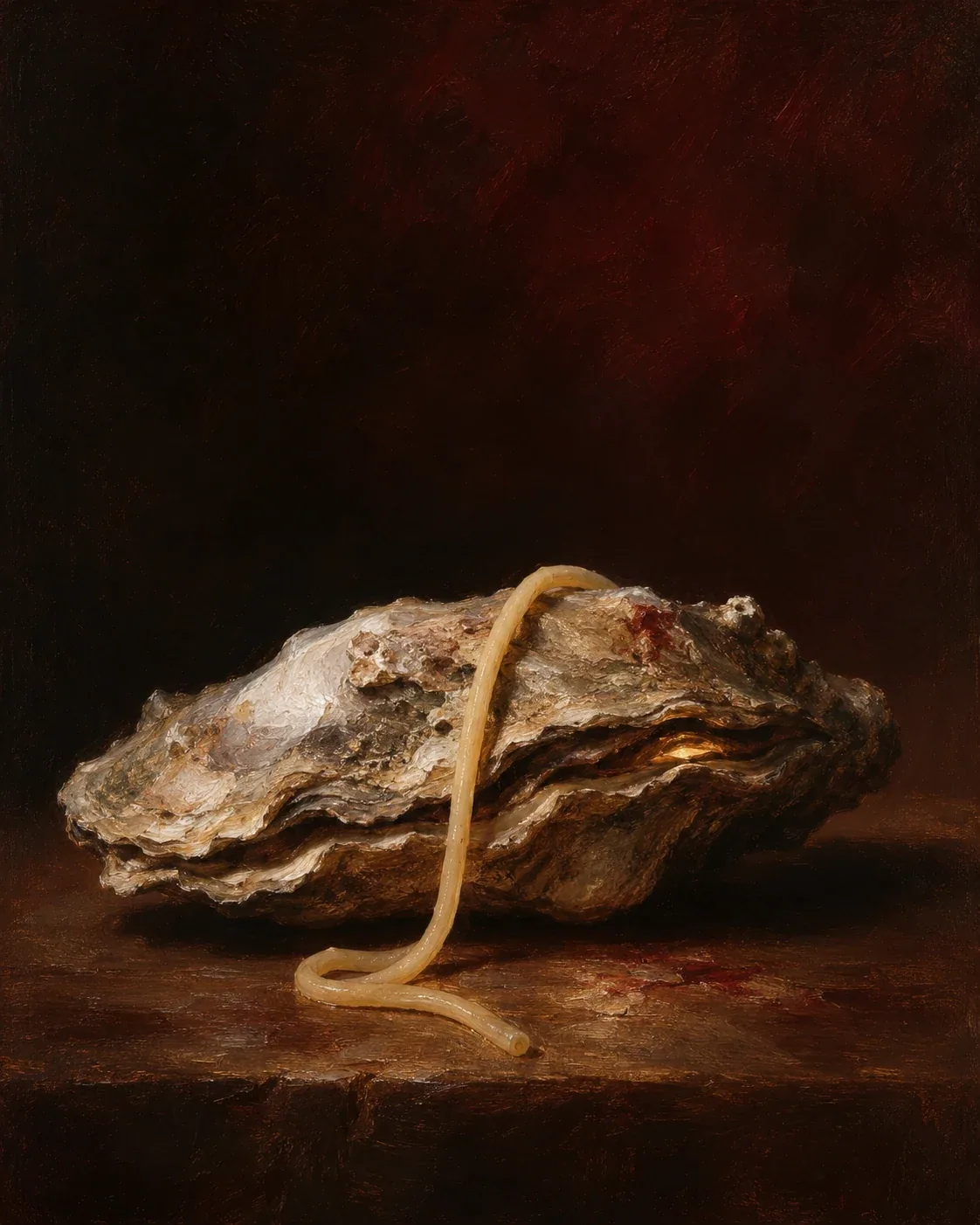
“You cannot open an oyster with boiled spaghetti.”
Leo
What if the oyster is inside my head?
Moers
Then the question is not whether you have failed. The question is why you keep trying to operate the oyster with spaghetti.
Socrates
And what would you use instead?
Moers
An oyster knife, naturally. Or a competent oyster opener. Anything, really, except a limp noodle and a philosophy of perseverance.
Leo
But the struggle has become part of who I am.
Moers
Then your oyster has become a remarkably successful landlord. It eats your furniture, closes your curtains, and persuades you that the darkness is a triumph of interior decoration.
Camus
Changing the instrument is not surrender. There is no dignity in repeating an impossible gesture only because it has become familiar.
Moers
And please, gentlemen, do not mistake the noodle for the pearl.
For a moment even Schopenhauer smiles. The oyster remains closed, but Leo no longer blames the spaghetti.
05 / The self and the shadow
Who remains without the wound?
Kierkegaard
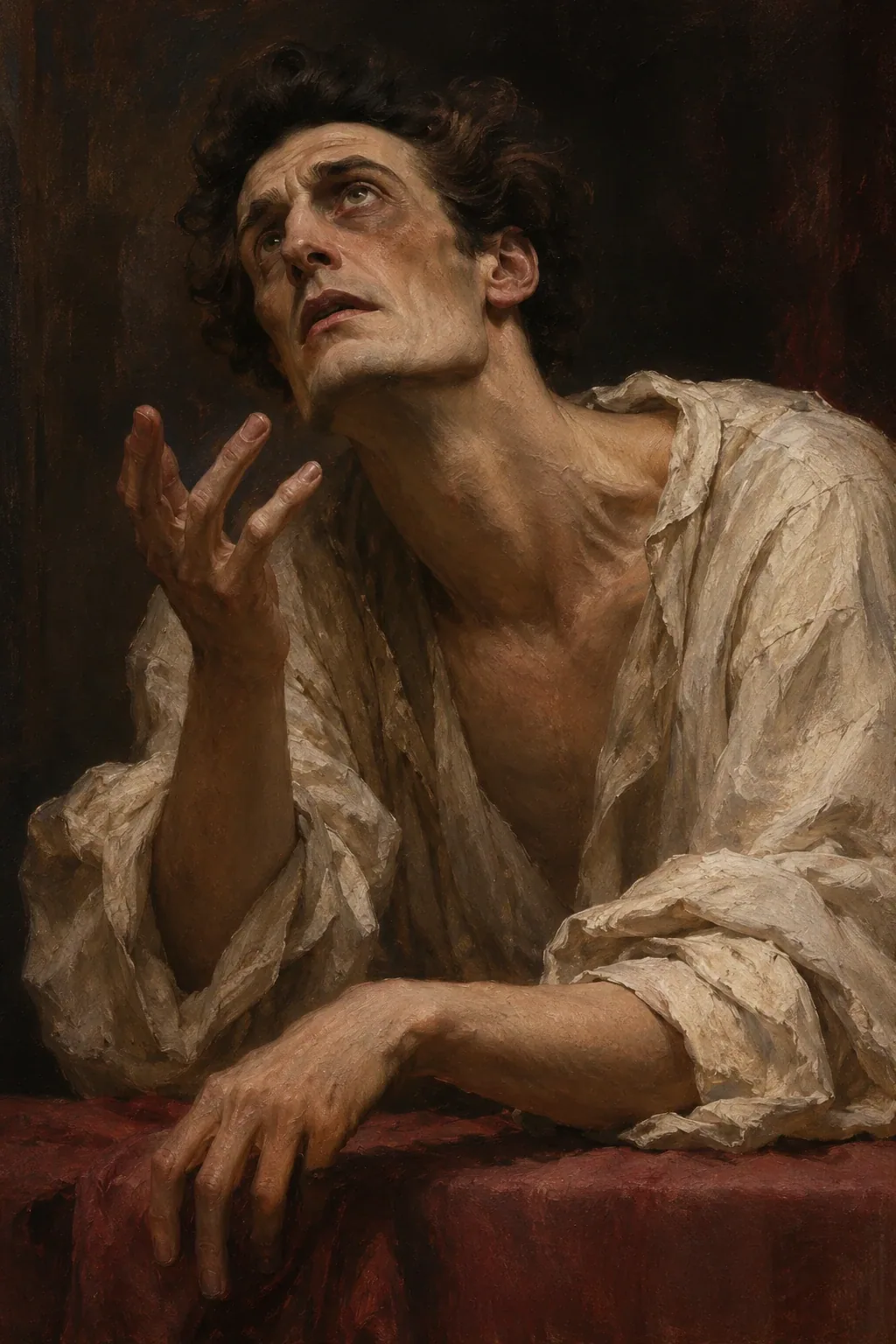
There is a despair in which the self cannot bear being itself. We become strangers inside our own interior.
Kant
The diminished ability to act does not diminish human worth. Dignity is not a reward for strength.
Leo
But if darkness has lived in me for years, how do I recognize myself without it?
Frankl
Meaning can sometimes be found in suffering that cannot be avoided. That does not make suffering a prerequisite for meaning.
06 / The table grows quiet
The wound is not the whole person.
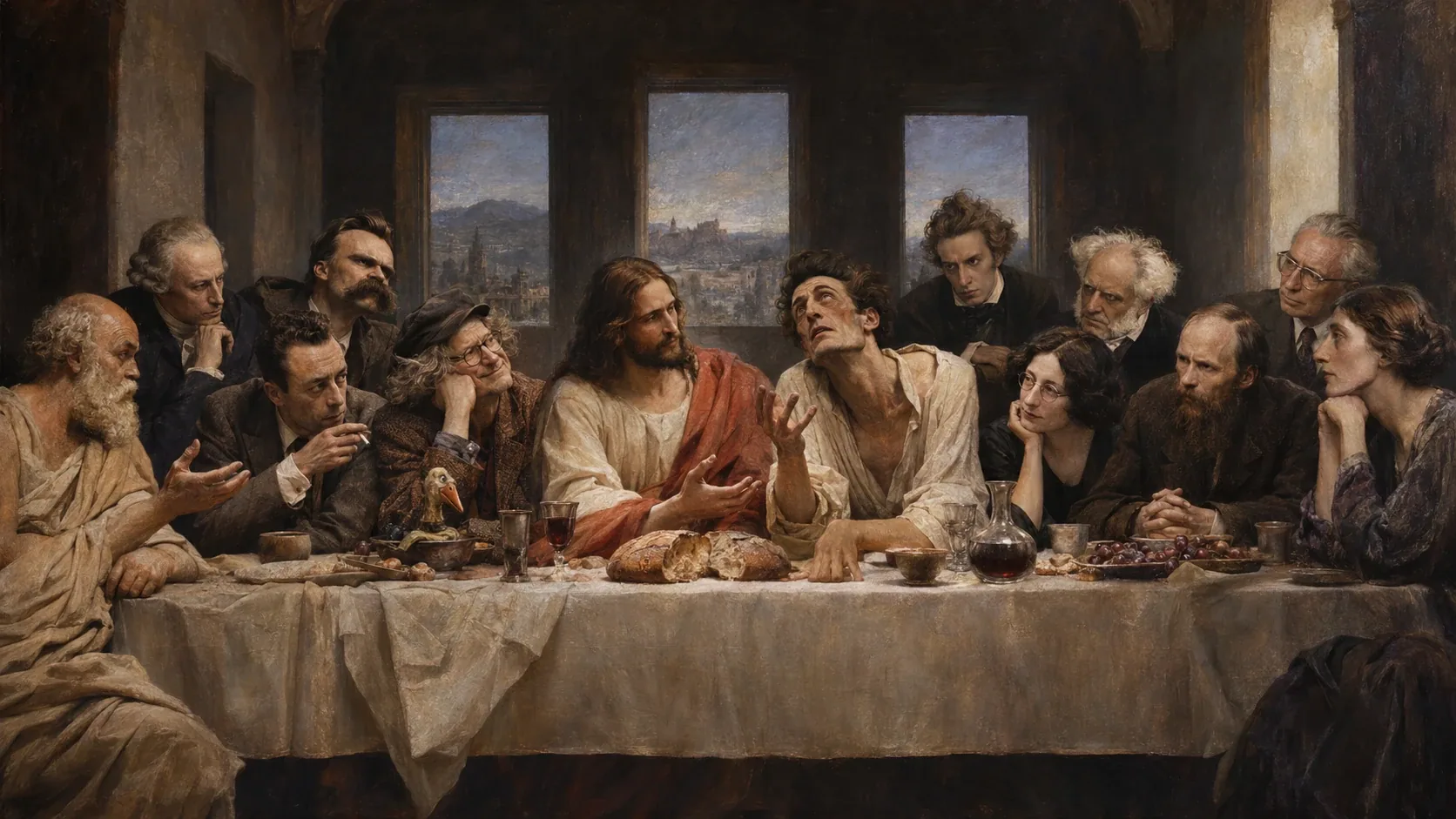
Leo
If depression has changed my way of seeing, does letting it go mean losing something essential?
Jesus
Do not mistake the wound for the whole person.
Camus
Knowing that life can hurt is part of consciousness. Being held captive by that hurt is not a condition of wisdom. You can refuse the prison without denying that you have lived inside it.
Leo
Then perhaps suffering belongs to the human condition, while depression need not.
Camus
Perhaps. We do not need to settle the meaning of the universe before deciding that there is more to see.
The unfinished autopsy
The capacity to suffer may be inseparable from consciousness. Depression, however, may not be its price. Perhaps the extraordinary individual and the darkness have only occupied the same body.
Could we be just as profound without the suffering?
There is no final verdict. The conversation continues outside the frame.
All philosophical dialogue is fictional and does not represent verified historical quotations. Leo's initial text is preserved in essence and lightly edited for presentation. The oyster-and-spaghetti line was supplied by the exhibition author; its attribution as a published Walter Moers quotation is unverified.
The distinction between philosophical suffering and clinical depression is deliberate: the work does not claim that depression is a prerequisite for art, greatness, or consciousness.